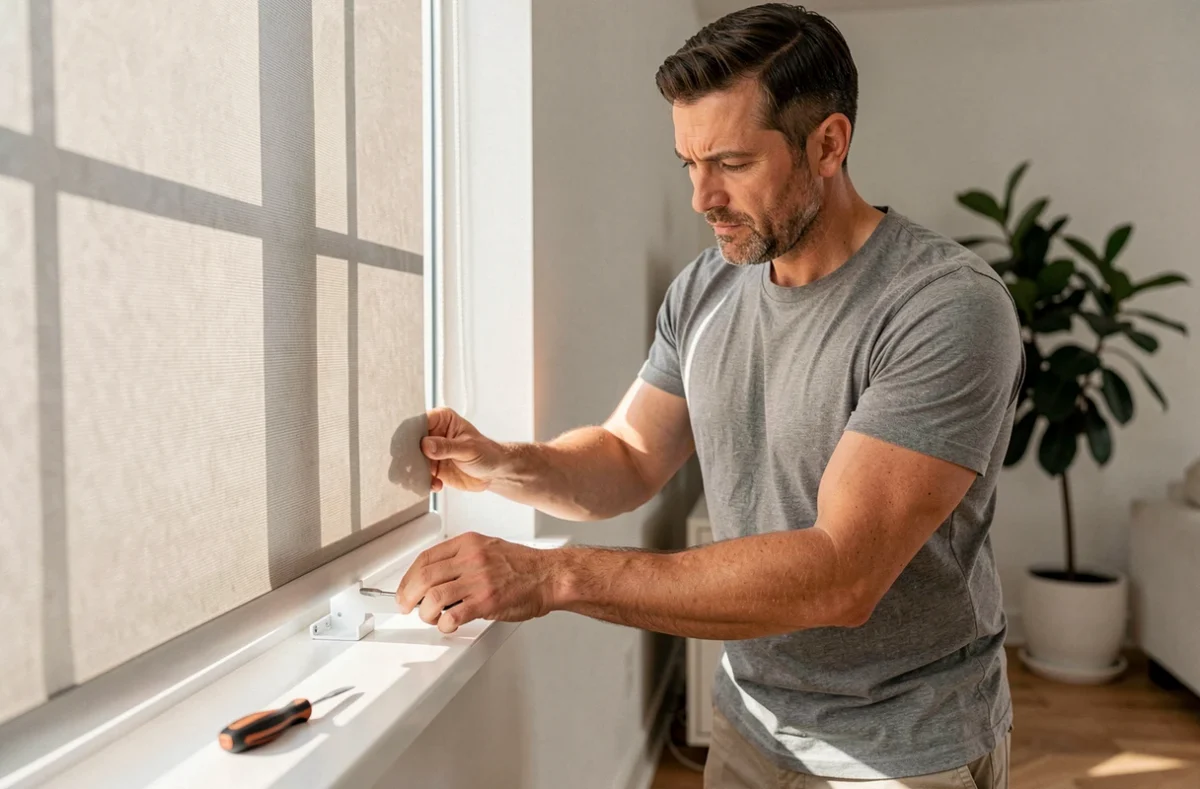
A roller blind that refuses to go back up, a chain that spins freely, or fabric that hangs crooked: these problems affect a simple mechanism, but every part has a specific role. Identifying the faulty component before touching anything helps prevent a minor issue from turning into a full replacement.
1. Diagnose the type of jam before doing anything
First, lower the blind halfway, then let go. If it rises on its own but stops before reaching the top, the return spring has lost tension. If it does not rise at all, the problem is more likely with the clutch or the roller tube.
A blind that lowers at an angle indicates that the fabric is misaligned on the tube or that a mounting bracket has come loose. A chain that slips without engaging the mechanism points to a worn sprocket or a deformed link. Each symptom points to a different part, and the rest of the repair depends entirely on identifying it correctly.
If you want to repair a roller blind easily, this diagnostic stage is the most important: it helps you avoid buying an incompatible kit or dismantling a part that still works.
2. Remove the blind from its brackets without forcing the mechanism
Most roller blinds rest on two clip brackets attached to the wall or ceiling. To remove the blind, lift the tube slightly, then release it from the side opposite the mechanism (the chain side is usually secured by a tab).
Pulling the blind down to remove it is a common mistake. This puts strain on the internal spring and can damage the clutch. Lifting it and then sliding it horizontally protects the mechanism.
For models secured with through-screws rather than clips, unscrew the brackets themselves. Keeping the screws in a labeled bag makes reassembly easier.
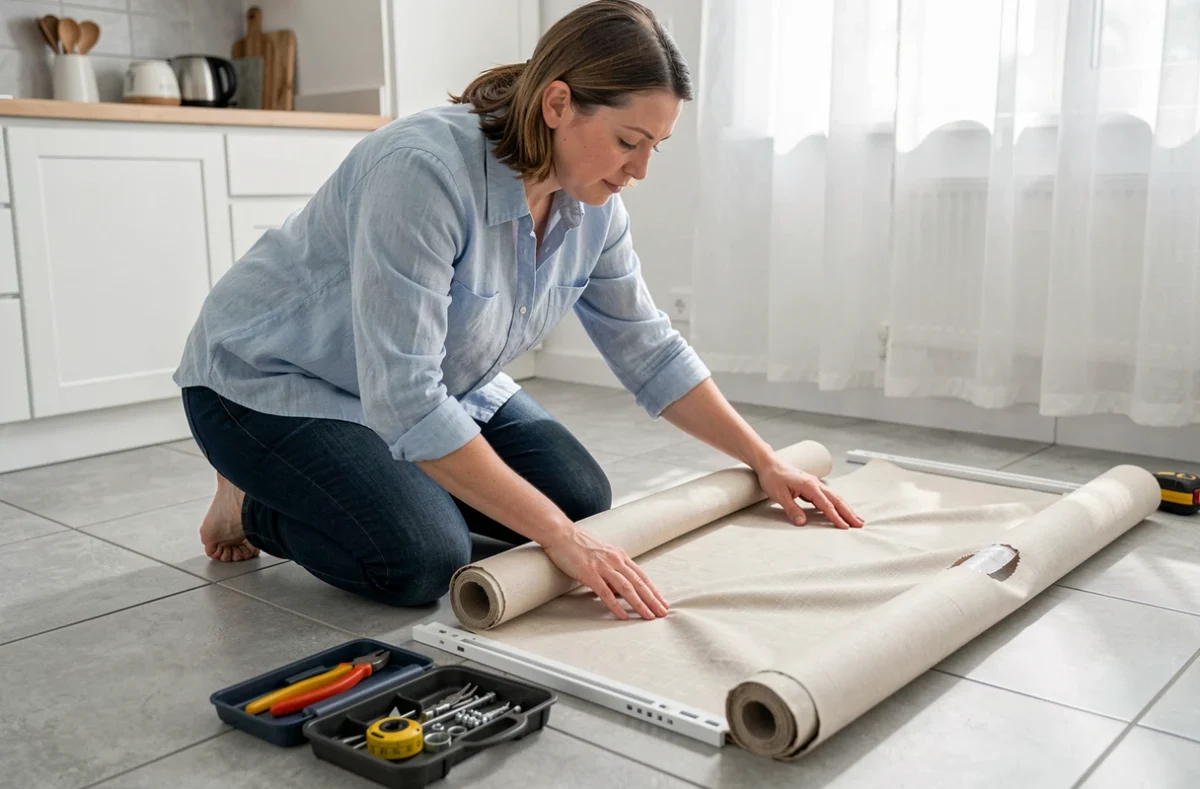
3. Retension the return spring when the blind no longer goes up
The spring inside the tube stores the tension needed to raise the blind automatically. When it weakens, the blind stops halfway or slowly drops under its own weight.
Retensioning it is straightforward: manually unroll the fabric two-thirds of the way, put the blind back on its brackets, then pull the fabric all the way down and let it rise. Repeating this two or three times gradually recharges the spring.
A spring that fails to regain tension after several cycles is worn out and cannot be fixed with a simple adjustment. In that case, replacing the entire mechanism (tube, spring, and end plug) is the only lasting solution.
4. Replace a broken chain or a deformed link
A roller blind chain is made up of plastic links that wear out over time. A clean break is easy to spot, but a stretched link often goes unnoticed and causes the mechanism to skip.
There are two types of links on the market:
- Snap-fit links, which clip together by sliding both ends of the chain into the connector
- Press-fit links, which require pliers to push the ends in until they click into place
- Complete chains sold by the metre, which can be cut to match the original length
Before ordering, measure the pitch between two chain beads (centre to centre) to ensure compatibility with the mechanism’s sprocket. An incompatible pitch will cause the chain to slip, even if it looks identical.
5. Realign fabric that hangs crooked
Misaligned fabric winds unevenly around the tube, creating a bulge on one side and a gap on the other. The fabric itself is rarely the cause.
The most common cause is a mounting bracket that is slightly out of position or loose. In most cases, checking that both brackets are level with a spirit level and tightening the screws is enough.
If the brackets are properly aligned, the fabric may have slipped on the tube. In that case, peel it off the adhesive or remove it from the tube’s groove, centre it by measuring the overhang on each side, then reattach it. A shift of just a few millimetres is enough to cause uneven winding.
6. Check chain safety after repairs
European standard EN 13120 addresses strangulation risks associated with indoor blind chains, particularly in homes with young children. After any work on the chain or mechanism, do not overlook this safety check.
Points to check:
- The retaining device (wall clip or tensioner), which prevents the chain from forming a loose loop, must be reattached in its original position
- If no safety device is installed, the chain must not hang below the window sill
- Newer models offer chain-free controls (crank or motorized operation) that eliminate this risk
A repaired blind with an unsecured chain remains a potential hazard, even if the mechanism works perfectly.
7. Know when a repair is no longer worthwhile
On a manual roller blind, a broken clutch, a bent tube, or a dead spring can often bring the cost of replacement parts close to the price of a new blind. Repair kit compatibility depends on the manufacturer, tube diameter, and type of end plug, making partial replacement even more complicated.
For a faulty motorized blind, the diagnosis is different. A motor that no longer responds may indicate an electrical problem (an incorrectly set limit switch or a worn capacitor) rather than a mechanical fault. Working on a tubular motor without electrical expertise risks a short circuit or incorrect wiring.
A practical rule: if the diagnosis points to two parts needing replacement at the same time, or if the model is no longer sold and compatible parts are impossible to find, replacing the entire blind is more reliable than assembling mismatched components.